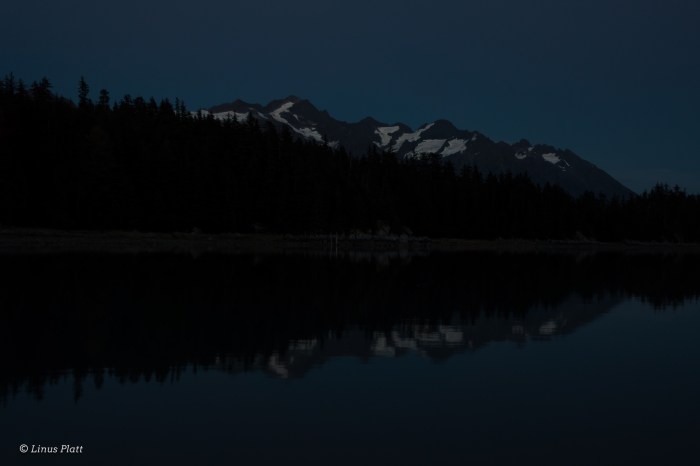
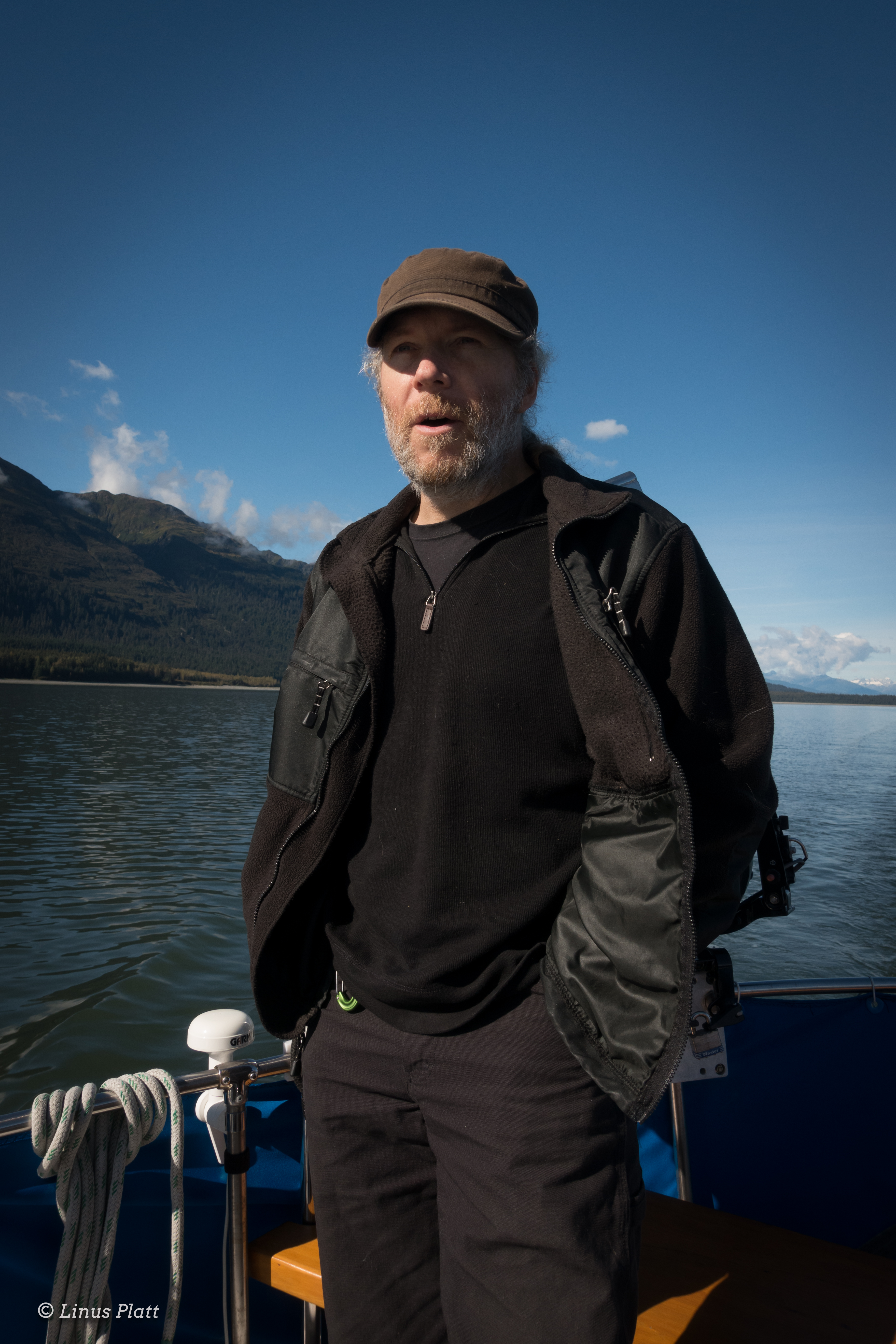
After talking of it for weeks, my good friend Gene and I decide to take a weekend and sail his boat down to Sullivan Island, which is situated in the confines of the stunning Chilkat Inlet about a dozen or so miles south of Haines. The weather is remarkable: so good in fact there is no wind for sailing, so motoring down the Inlet we go, bound for glacial outpours, rugged mountains, hidden canyons, unnamed rivers, Grizzly Bears, and spawning Salmon.
That evening, moored just off the shores of Sullivan and drinking wine while gazing at the eerie mist engulfing the inlet, a ghostly and unexpected whale surfaces in the dark and breathes loudly through it’s blowhole. Neither one of us knew that any whales were in the inlet this time of year.. a gift.
The next day, calm and serene, the mountains and glaciers shining bright, we motor up inlet to an unnamed river to inspect. A massive Cottonwood sporting a huge Eagle’s nest, giant Grizzly tracks, unexpectedly hidden canyon and glaciers, and loads of coyote tracks. We hike perhaps a mile upstream before turning back. I vow to myself to return to this place and hike the distance through the hidden canyon to the splendid glacier beyond. Another trip; I must get a boat!
It is jaunts such as these that remind me that Haines is a most fantastic place on this Earth, and I call it home…
Alaska Coast Range and Sullivan Island
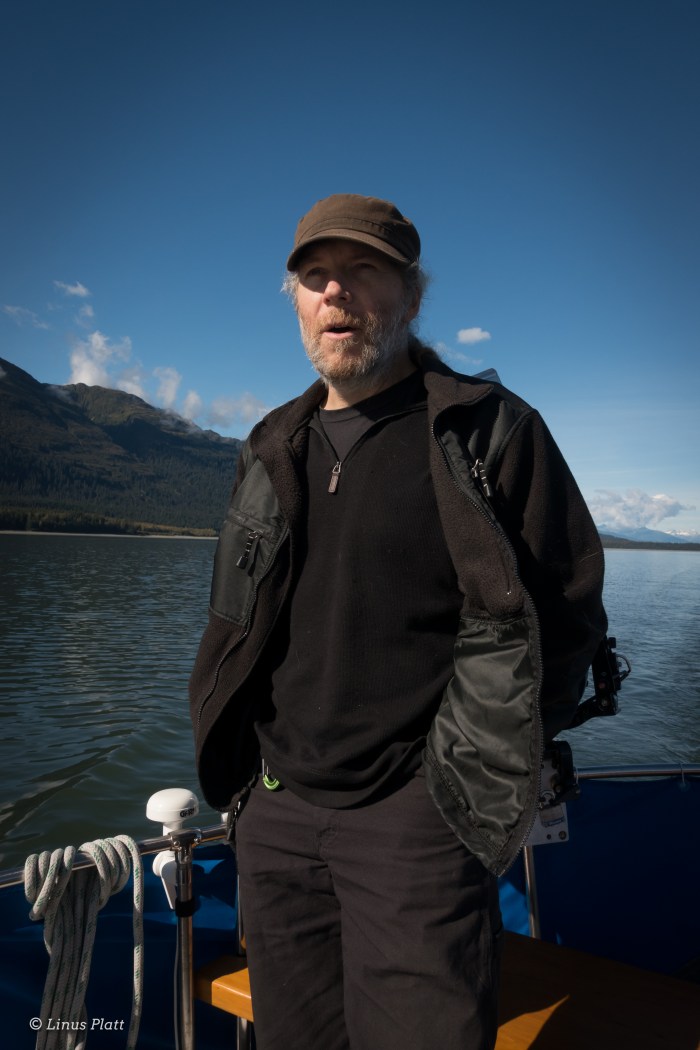
Un-named river and glacier…The Towering Granite Walls of the Alaska Coast RangeLooking to the Chilkat Range from the BoatEagle’s Nest and Sail BoatRescue Bay Sullivan IslandShining Glaciers at DuskCap’t Gene
After getting mentally and physically prepped for the last couple of weeks, I awake one Monday morning and decide that leaving several days early on a ride of the North’s “Golden Triangle” is in order. My boss and co-workers seem to have no issue with the notion, and off I go to take care of last minute details at home.
Some folk’s call the ride in question the ”Alaska Golden Triangle”, which is a misconception since most of the ride occurs in Canada’s Yukon Territory. The route however, starts in Alaska, crosses British Columbia, traverses about 180 miles of the Yukon’s mighty interior, crosses back into B.C., and finally ending in Alaska at Skaguay. The first few miles and the entirety of my first day pedaling consist of the Chilkat and Klehini River corridors through the beautiful Chilkat Valley, ending at the Canadian/ U.S. border and the beginning of the climb up to Haines Summit, more locally known as Chilkat Pass. This Pass separates the interior of Northern B.C. and the Yukon from the coastal and heavily glaciated Chilkat Mountains and Alaska’s ice capped Coast Range, of which temperate and maritime systems exist at their feet. It is in this coastal region that Haines, and my home exist.
Going to bed a bit late and waking casually, I dress in my normal bicycle traveler garb consisting of loose fitting nylon pants, t-shirt, Loose fitting long-sleeve shirt, and lace up cross training footwear. Onto the Ogre, I spin into town to meet with Angela and grab some coffee and breakfast before commencing to the endless highway.
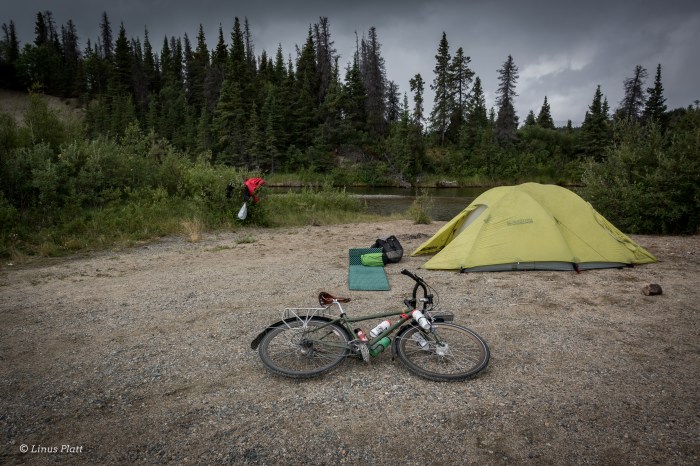
After a casual time at Sarah J’s eatery in Haines, I say goodbye to Angela and begin the flat and pleasant cruise up the highway in hopes of finding a good camp near the border. Hours later, a faint path appears on the river side of the road leading through the Alder thickets and ends abruptly on the Cotton Grass flats above the Klehini River. A great camp with views of the Saksaia Glacier and fine and tasty drinking water direct from the river has me smiling on this first evening of the trip.
Many bicycle travelers it seem have a burning desire, especially in the northern tier, to seek out camping in “official” and pay campgrounds where other people gather. To my thinking, this never really made any sense, not here in the northern wilderness, where some of the best and most plentiful free range camping are to be had for the taking. Why pay to sleep when one can create their own world wherever one wishes? Many claim it is their fear of Bears. After spending more nights out in the Alaskan and Yukon bush than I can count, I believe that the Bears have far more to fear from Humans than the contrary. Of course extreme occurrences can happen, but being smart about the way one camps greatly diminishes these chances. In fact, I believe that having Bear problems are increased in public camping areas where Bears may be conditioned to Humans and their glorious trash. As far as the social thing is concerned, well, to each there own. Camping alone in these wild places allows me breathing room and a purposeful reflection towards the natural world and creates in me a great and humbling respect for it. This is where I can watch the river flow and the Falcon soar; hear the wind blow and smell the sweetness of the North in the air unencumbered by a Human world that tends to feel dominance toward all I see before me. That said, loneliness could from time to time drop in for an unexpected visit. But not tonight.
The morning sees rain pattering the rain fly of the tent and I must say I dread it, since today is a big climb up to Chilkat Pass, where I am hoping to spend more than a day hiking and bagging a peak or two if the weather cooperates, But, cooperating it is not and I pack up my little world and spin the mile up the road to the Canadian Customs gate and soon I am climbing upward into the big grind known as “Marinka’s Hill”, the primary climb up to the pass. The rain shows no sign of letting up and I don rain gear and continue, sweating as much on the inside of the clothing as the rain on the opposite. As the storm intensifies, I realize there will be no hanging around and leisurely climbing mountains, but instead, waiting the fury out tent bound. Just past Three Guardsmen Lake, in a low hollow just before the main summit, I pitch my tent and dive in. For the next 18 hours I read, eat, drink a beer or two, and sleep. The following morning the rain is continuing, but I must go on and the tent is put away wet and the pedaling continues. At the pass proper, the rain stops, clouds open, and glorious sunshine reveals itself, if only for a few minutes. Then it begins again. But heavier this time. Soon torrential downfalls of drops appear, and for a moment, even the roadway ahead is barely visible to my eyes. Although a part of the journey, especially in the North, rain can make the difference between pure suffering and pure bliss on a bicycle voyage.
Later, after the rain lets up, I cross the Yukon’s Takhanne River and set up a pleasant camp next to the water and bathe my foul clothing and myself. Snacking on my supper that evening, I watch a Hawk harass the Swallows at the entrance to their mud nests burrowed deep into the ancient riverbank. Clouds gather and then part again while the sun peeks in to cast great and colorful splashes of yellow and orange against the rocky mountainsides before me. Patches of deep blue sky swirl around the sun/cloud union like a predator in pursuit. At midnight, a Loon cries out from somewhere nearby, and the only thing stirring now is the soft and occasional breeze gently touching the tops of the Spruce and Aspen stands situated nearby camp.
To my ears, the call of the Loon is one of the most enjoyable and haunting sounds coming from the forest and lakes. It is nearly as engaging as the sound of the Wolf howling in the dark of night. And as I pedaled the next morning up a monstrous Yukon hill, one of the biggest of the trip, the Loons were creating a symphony of joyous monotony pushing me upward and over that mound and deeper into the great Yukon interior I love so much. I meet a 64 year old French man on a decrepit bicycle, heavily loaded and carrying an axe for which to chop twigs for his home made hobo stove. He has spent a great deal of his life traveling by bicycle in various parts of the planet, and travel in these parts is not alien to him. Later in the day, I take a side trip to the ancient native village of Klukshu. A side trip of about a half mile leads to the small but Salmon heavy Klukshu River, where native people have been harvesting Chinook, Sockeye, and Coho Salmon for millennia. I arrive at the bank of the tiny river; a Sockeye splashes about as it sees me, there is not a soul around but the fish and myself, lest a Bear hidden in the forest nearby. The village is deserted. There is something going on here that is unexplainable; there is an ancient sensation that I am somehow connected to that feels both like sadness and deep connected love. The air feels thick with history and community. Tears swell my eyes as I sit next to the river; this strange place I have never been feels like home. It is strange indeed. If there is such a thing as past lives, then I’m certain I was a Native North American. I pedal onward and past the equally haunting and beautiful Kathleen Lake and the beginning of the colorful and rugged Kluane Range, forefront to the overwhelmingly enormous St Elias Range and Mt Logan. Home to the second tallest peak in North America and some of the biggest and expansive ice fields and glaciers on Earth. The Yukon is a mind-blowing place indeed. Soon I am rolling into Haines Junction for a meal and some re-supply on food and luxuries.
Now I am into the thick of things. The Alaska Highway is traffic heavy compared to the mellow Haines Highway, where trucks shipping supplies from Canada to Alaska whiz by at maximum speed and clueless tourons barely in control of bloated recreational homes-on-wheels as big as my house meander down the pavement, gawking at the scenery and not watching the road, too lazy or disinterested to actually stop and explore beyond their steering wheel, most of these southern travelers never really see much at all.
The pedaling is flat and windless; miles fly by. The Ogre slithers along in silence. The endless boreal forest of the interior swallows me up and I am one with it. Arctic Ground Squirrels scurry in and out of the roadway as if attempting to throw themselves under passing vehicles. I often hear bicycle travelers complain about the sometimes endless and monotonous stretches of Alaska and the Yukon’s boreal timberland, saying that it is a dread to ride through it. Beats riding through most anywhere down south if you ask me. I connect with this forest; to me, this boreal play land is an endless supply of tranquility, animals, lakes, rivers, muskeg, swamp, taiga, streams, and beauty. There is a living breathing force here that cannot be ignored. To me, there is nothing monotonous about it. Riding through endless highway traffic and Human civilization is monotonous, dangerous, and disturbing-nowhere to camp either.
The climate and terrain is changing rapidly from a wet mountain environment, to an almost desert like boreal landscape that reminds me somewhat of western Colorado. A several mile gravel section of road appears near the Native village of Champagne, and I unknowingly watch as the last stream goes past and some 25 miles later, I am running low on water. At the 61 mile mark for the day, I emerge on the banks of Stoney Creek; a crystal clear mountain stream perfect for both drinking and bathing, and with an endless supply of ripened Raspberries growing adjacent to it’s flanks. I call this lovely place home for the evening and settle in with a sizeable grin adoring my mug, all the while snacking on raspberries for dessert.
In Whitehorse, I’m tossed into a world I have not seen in a long time. Since moving to Haines nearly three years ago, I have not left at all, except to go see an orthopedic last year when I broke my ankle at work. Haines is a quiet little Alaskan town; very little commotion at all. Whitehorse on the other hand, although quite tame by modern city standards, was abrupt, fast, and in my face a bit. I actually like Whitehorse. It is a small city of about 40,000 souls, with tons of mountain bike and hiking trails, the glorious Yukon River, and surrounded by endless wilderness. But on this day, to me here and now, I just wanted to get through it and back to my forest. Pedaling through town finds me along the Yukon River and past the hydro power dam and on the shores of Schwatka Lake, a Human made reservoir with float planes and powerboats here and there, but still a beautiful and serene place to be camped. That night, I awake about 1:00 am and noticed the first star in the northern sky since late April. Summer is slowly closing down and the days are getting a hair shorter each cycle. Before you know it, there will be some of the white stuff back on the ground, the tourists will be back in Florida, Texas and all parts south, and the Bears will be heading to their high country denning grounds to await the next round of Salmon entering the rivers in May.
Heading south on the Klondike Highway in the morning, I pedal all the way to Spirit Lake and devour a breakfast there before spinning down into Carcross (Caribou Crossing) and the beginning of what is known as the “southern lakes region” of the Yukon. In this part of the Province, there are many, many extremely long, deep, cold water lakes; meltwater remnants of the massive glaciers that covered this part of the Yukon a millennia ago. These lakes are a thing of beauty to say the least. Encased in wilderness, and rising from them mighty mountain ranges so remote, few have seen their endless and omnipotent shores outside of a powerboat. Soon, I can see the coastal mountains rising from the horizon and the beginnings of small yet prominent glaciers adorning their sides. The road now traverses the Windy Arm of Tagish Lake and around the bulk of Tutshi Lake, where this highway begins to tilt upward a bit, and the Yukon/B.C. border comes and goes. More climbing in the distance I can see, for White Pass is ahead, separating Canada from Alaska and the end of my Journey at Skaguay.
Finding no outstanding place to camp, I reluctantly pedal mile after mile, passing mediocre spots hoping the Golden Camp Spot will appear. After 76 long and exhausting miles, the fabled glory camp does not appear, and I throw down my nylon ghetto onto a deserted gravel pit and enjoy myself regardless, happy to be off the bike once and for all for the day.
Up bright and early the following morning I am sore, and there are rapidly moving clouds and wind coming through, but I feel good. It is only about 20 miles to White Pass from here according to my calculations. The road turns gently and ever so slightly upward from here and the landscape changes once again from the sub-alpine boreal forest to the higher and more colorful alpine arena of tundra, swiftly moving streams, and low lying brush and stunted Pine and Spruce. The route follows a glorious emerald river, adorned with many rapids and small waterfalls. A Bald Eagle soars overhead, and a Gull meanders behind, perhaps hoping to reap any benefits the Baldy might conjure. The wind picks up and it is a struggle to keep the Ogre upright on the hills. At timberline, the first of many low lying alpine lakes appear, and the stiff breeze grows fierce. Glaciers show themselves briefly during interludes in the cloud cover and before long they disappear once again into the thick alpine mist. Near the pass, I clamber over granite boulders to get a good look at Summit Lake and onslaught of the storm; wind and whitecaps embellish the lakes surface. A Gull scares up and hovers over me, squawking loudly that I must leave. She must be protecting a nest. I wish her well and skedaddle back to the bike and finish the last bit of the climb to the pass. At the top, a great and magnificent alpine meadow sits below and decorated with a mighty waterfall, so picturesque it is difficult to believe it real. At the pass, the weather is foul, and thoughts of espresso and a hot meal entice me. I peer at the highway ahead and it is a steep downhill for 14 miles to the sea. I had ridden up this massive hill back in 2013 when I rode from Skaguay to Deadhorse to Valdez, so I had gained a healthy respect for it’s magnitude. After tossing on my jacket and sporting hat and gloves, I fly downward and into the fantastic canyon, past more waterfalls and jagged peaks and soon there is no more. A gigantic cruise ship appears a half mile off; perched in the waters of the upper Lynn Canal, it’s passengers flooding the streets of Alaska’s biggest tourist attraction. I meander through the insanely crowded streets attempting not to hit or be hit by those not paying attention, which are many. It is a shock to the senses again. Haines will feel quiet and pristine compared to this insane asylum. Later, after a meal and some casual town observation, I board the marine vessel Le Conte for an hour ride down the canal to Haines, where a six mile ride from the ferry terminal deposits me back at my quiet little crib.
All in all, I had ridden most of this trip previously: the Alaska Highway portion back in 2011 when riding from Moab to Fairbanks, and the Klondike Highway/White Pass section in 2013 on the way to the arctic. Only the Home stretch of the Haines Highway over Chilkat Pass were new, but it is an outstanding pedal through some of the most beautiful countryside the North has to offer. I may even ride it again. Complete with a side trip to Klukshu, some exploring of random dirt roads in the forest and the pedaling in Whitehorse and looking for camp spots, I had pedaled about 385 miles over eight days. I can’t think of any reason why one would attempt to do it any faster; there would be too much to be missed, and in my opinion, far less enjoyable. These trips are not a race folks; they are to be felt and appreciated.
The Ogre pulls off another one.
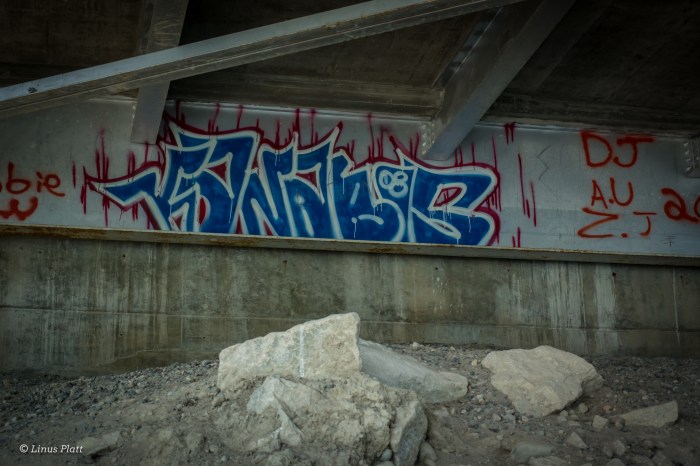
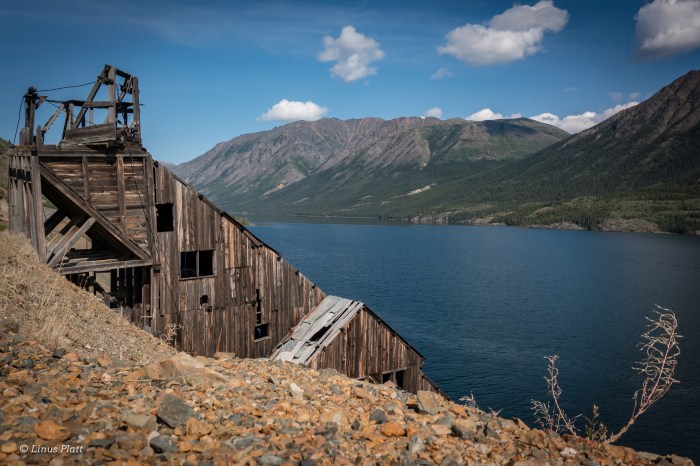
Klehini River CampStormboundChilkat Pass ClimbHaines Summit AKA Chilkat PassStickered SignAlpine Tundra LandscapeThe Green Hut Emergency Shelter Near The PassWhite Spruce And B.C. GlacierNorther British ColumbiaTakhanne River YukonTakhanne CampApen StandsEntering The Native Village Of KlukshuMoose Antlers And Satellite DishCabin and Fish Drying HutCache and Fish HutAspen GrovesMountains Near Kathleen LakeKluaneThe New Grocery Store In Haines JunctionAlaska Highway Gravel Near ChampagneTakhini River Area Yukon InteriorGood SnacksWild Rasberries At Stoney CreekTakhini Bridge GraffitiLove These!CarcrossTagish LakeHistoric Abandoned Mining Structure Along Windy ArmSummit LakeSummit CreekWhite Pass AreaLooking Down From White PassWhite PassMoore Creek Near Skaguay
The bicycle know to me as the Surley Ogre has been on hiatus for some time now…over two years in fact. Like a horse put out to pasture, she has endured this lengthy time situated in the garage amongst the miter saw, planer, router, and other tools of construction. Not fitting in with these apparatus, she squeals and begs for a letting of road miles. In anticipation of an upcoming trip upon her to the mighty Yukon and beyond, I strip the old gal down to her bones and a cleansing and rebuilding ensues.
It has been far too long since the Ogre and I have embarked upon the open road together, and in a quick fit, I work out a stretch of time off from work and make preparations for us to engage the Alaska Golden Triangle; Riding from my house in Haines to Haines Junction to Whitehorse to Skagway. A 360 mile loop through the northern panhandle and into B.C. and the Yukon, ending back in the good ‘ol AK in Skagway, where a quick ferry ride home ends the adventure. With plans to leave on the 29th of July, and returning on the 13th of August, I must say that these bicycle trip are certainly not about the bike. Or even riding them. These excursions are about being there. Or more precisely, being out there and taking in the tundra, mountains, rivers, and wildlife. If I was in shape and looking to make some quick time, I would theoretically make the journey in six or seven days. I think not. I intend on going slowly and enjoying the vast and wonderful summer in the North. Summertime in the regions of Alaska, Northern B.C., and the Yukon are stuff of fantasy to me. It is a time of exploding life and glorious exploration. There is nothing better on Earth than summer in the North.
Having a couple of weeks lead time to the trip in question, I head out to test the newly constructed Ogre for a quick 20 mile excursion up the wonderful Haines Highway, and as luck would have it, a spectacular day of temps in the 70’s, glorious sunshine, and the glaciers of the Chilkat’s shining brightly.
The old girl, spaced out from many months at pasture, bucks wildly when I attempt to pedal forward. After a rough patch, we hit our stride and suddenly it’s just like old times.
As out of shape as I am, I am looking forward to that big nasty climb up Chilkat Pass and into the Yukon I love so much. Two weeks and counting…
Stay posted friends!
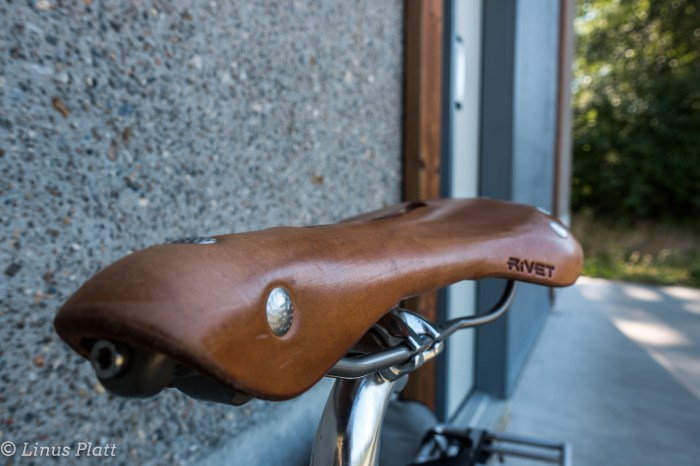
The omnipotent Surley OgreThe Rivet PearlThe Ogre rests by the mighty Chilkat RiverChilkat Cathedrals and Ogre
Let’s see now: I moved to Haines on November 3rd 2013 and it is now June 8th 2016. Now mind you, other than going to Juneau twice to see quack doctors about my broken ankle (I am not a fan of going to Juneau), and once heading up to Haines Junction in the Yukon with my Mom and Angela for a day trip, I have not really left Haines since that chilly day rolling down from Fairbanks in November more than 31 months back.
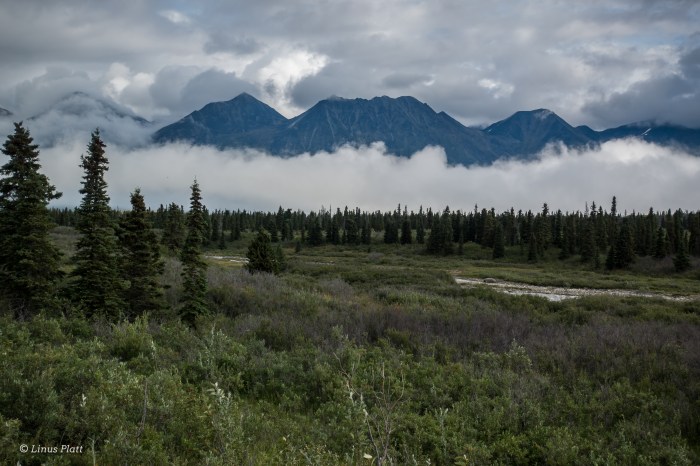
Seems my attitude has been at an all time low and a need for adventure has been halted due to my buying a house that I really cannot afford. Seems I have no time or money to enjoy the very reason I live here in Alaska. Things have been difficult for me at work as a result and finally, something had to give. Summer has finally arrived in Alaska, with temperatures in the 60’s and 70’s and daylight exceeding 22 hours now, I decide to break free for a weekend and head up to the Haines Summit area of British Columbia for a couple days of exploring and such. “The Pass” as it is locally known, is the dividing factor in separating the temperate maritime environment of the Chilkat Valley and Peninsula from the rugged alpine interior of B.C. and the Yukon. The Canadian border being 40 miles from Haines leads to the climb up Three Guardsmen Pass, and finally the higher Haines Summit being another 10 miles beyond. One Enters B.C., climbs the pass, then another 25 or 30 miles brings one to the mighty Yukon. The area around the pass is an area of high peaks, alpine tundra, glaciers, rivers, Ptarmigan, Marmot, Wolf, and Grizzly Bear. It is my kinda place to say the least.
After a quick visit with my buddy Gene on his sailboat in the Haines Harbor, I fire up the truck and head north. After a quick stop at Canadian Customs where I am grilled by the always grouchy Canadian Border Patrol, I am soon spinning the vehicle up the majestic landscape higher and higher to the land of rock and ice.
That evening I camp near the outlet of Kelsall Lake along side the mysterious Kelsall River. The mosquitos are thick, but the calls of the Loon and of the distant Coyote’s lull me to sleep. At 4am I pack up and continue north, into the Yukon just because I can. Being in the Yukon again is a fulfilling and sensational feeling once again. I really love the Yukon; there really is no place like it. It has a very distinct and isolated, yet remarkable feeling about it. It’s being up in the interior again that is putting wind in my sails…
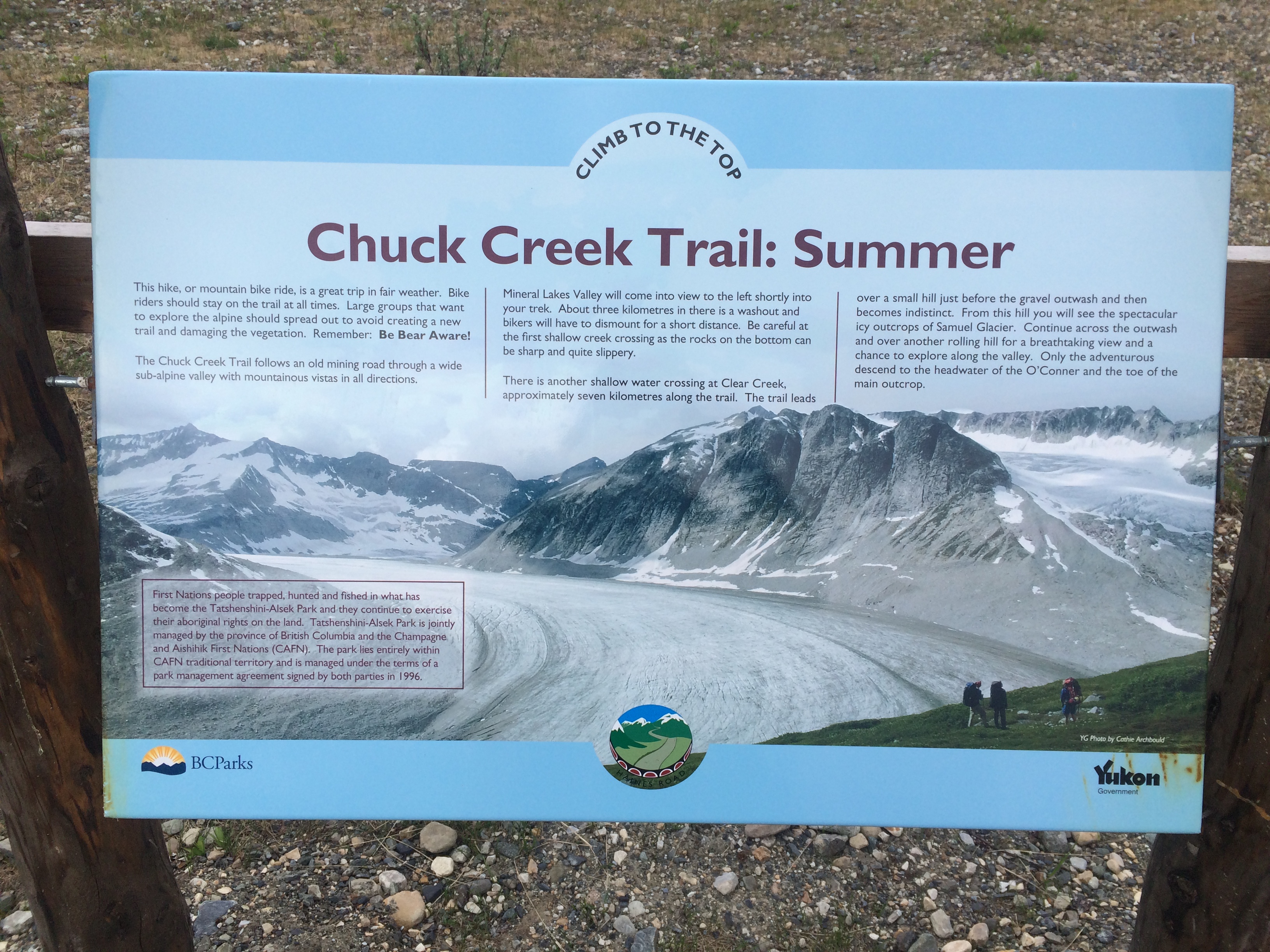
After a bit, I turn the truck around and head back south towards the trailhead for the Samuel Glacier, where and old mining road, after disappearing 4 or 5 kilometers in and turning into a true back country wilderness experience, leads to the wonderful Samuel Glacier, some 10 or 11 kilometers from the highway.
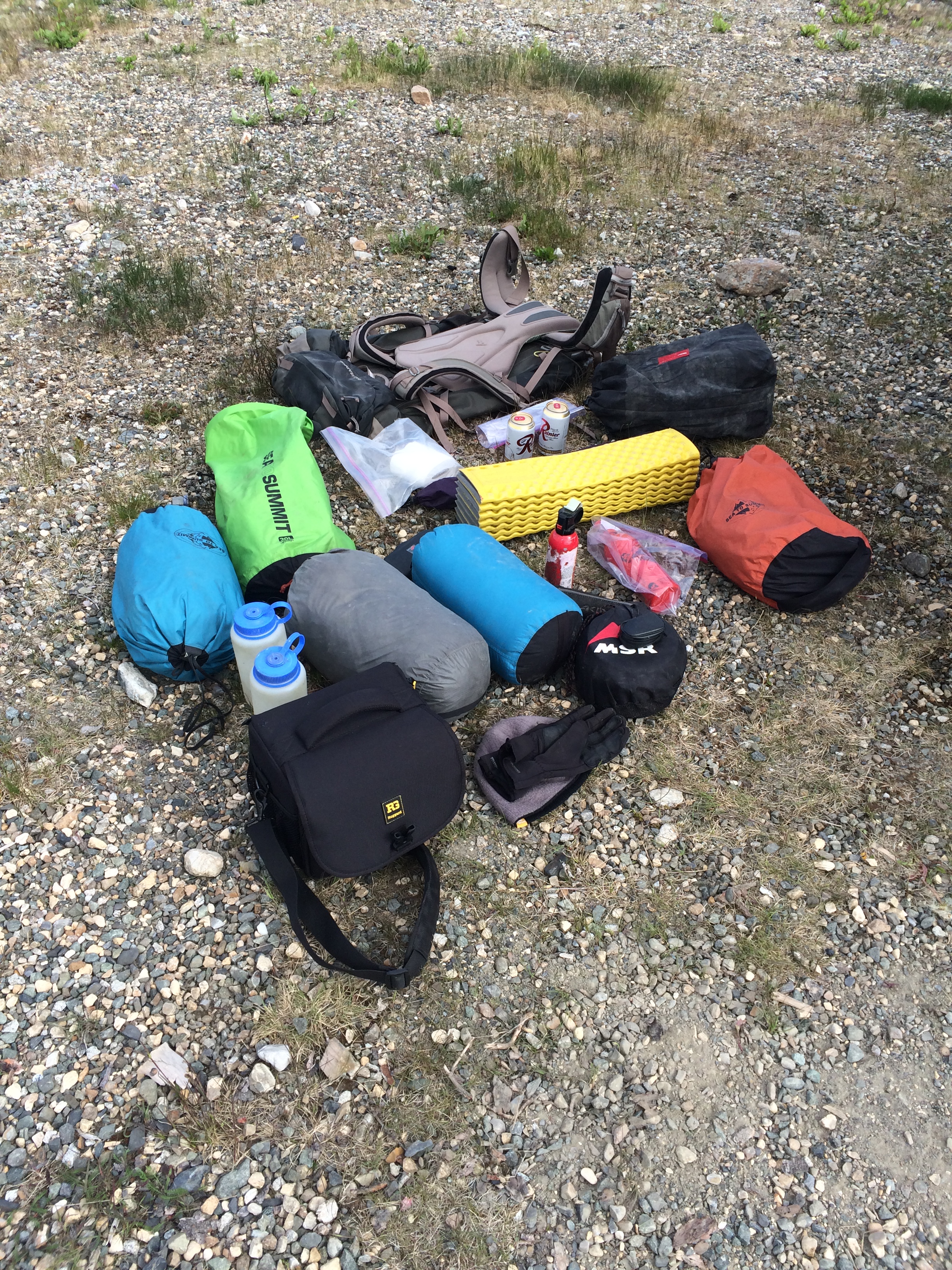
After finishing a breakfast of eggs and tortillas grilled over the trusty MSR, I pack up the backpack as light as I can to help make up for the fact that I will be carrying my Sony X70 video camera. I have currently my Canon DSLR listed on eBay, so decide not to bring it in fear of damaging it before a critical sale. The unfortunate reality of this particular photographic situation, is that my only photo option for this trip is the ever stupid iPhone! Man that camera sucks. But it’s what I’ve got for this adventure and after a brief packing session, I am on the trail.
The trail consists of an old mining road that is very easy to follow and is in exceptionally good condition. The trail wanders slightly uphill into a high alpine valley surrounded by streams, rivers and peaks. Groundhogs and Marmots seem to be everywhere; Ptarmigans scare up out of the low lying brushy tundra around every corner. The place is alive! I keep my eyes peeled for Grizzly Bears and Wolves, and soon I come to the first stream crossing that I must remove shoes for. The water is bitterly cold, but is refreshing to hot feet. After a couple more kilometers, the trail disappears under a vast snowfield hundreds of meters wide. I figure this is where my feet get wet permanently and dive in. Across the snowfield, the trail is no where in sight. I spy a river below and bushwhack to it’s shores, where another full blown crossing is in order. The trail re-appears briefly and I follow it till it once again dives beneath snow and tundra bogs. Gaining a high ridge, I spy a trail of in the distance, following the fast moving river I had just crossed. Had I gone the wrong way? It occurs to me at this point that I am here a bit too early in the year. July or August would be best I reckon. I trudge onward.
Soon, there is no sign of trail nor of human travel of any kind. It is just me and my running shoes, the snowfields and tundra tussocks, the mudbogs and river crossing, the Marmots and Ptarmigans. It is now genuine wilderness and I begin to feel at home. At every river crossing I come to, I simply charge right in, shoes and all and accept the fact that I now have wet feet. Traveling the valleys and ridges of pure trail-less tundra tussocks and mudbogs is fatiguing to say the least. I am nearing what I see is the end of my journey: The highland I am traveling suddenly stop up ahead another kilometer or so and what lies beyond can only be one thing: Glacier.
The tundra gives way to an alluvial plane of gravel and glacial deposits, with braid after braid of swift and dangerous stream crossings. At the edge of the plane, where it meets up with the endless tundra, lies a snowbank fitted with a long string of animal tracks. Getting closer, I see that the tracks in question are one of Wolf. A big one too. The tracks could be no more than an hour old as they appear fresh and crisp and un- molested by the exceedingly hot midday sun. I marvel at them and spin my head around in anticipation of seeing the animal, but I am alone. I cross the alluvial gravel bed and once agin climb onto the steepening tundra for a rather quick jaunt to it’s edge where the magnificent Samuel Glacier comes into view. I decide to drop down the other side of the tundra ridge and camp on a small hummocked shelf just a couple hundred meters above creaking ice. I am exhausted and once in the tent, I sleep a fitful sleep as the overhead sun is blazing hot in this barren and endless alpine tundra land.
A while later, I emerge from the tent, sun still high, and walk to nearby stream for water and photographs and some video shots. I see the Samuel Glacier and it adjoining glacial arm like tentacles from an icy giant protruding from the massive fault block pyramids of the Alsek Ranges that extend into the largest glacially active non-polar area of our planet, and home to the largest unspoiled wilderness on earth. I am fulfilled with great and massive appreciation for this place and I am happy to call it my home; Haines is a mere 80 miles away.
Back to the tent for supper and more sleep, I awake the following morning at 3:30 am to a gathering storm. I pack quickly and soon I am again bounding over tundra and listening to the rushes of the strangely human-like squawking of the Rock Ptarmigans. The first time I ever heard these creatures talking was in the Tombstone Mountains in the high Yukon back in 2013. The sounds they make are vaguely human and sound like a babbling insane person speaking nonsense. The first time I heard them was in the middle of the arctic “night”, and it disturbed me so much, I thought I was being stalked by a maniacal stranger hell bent on harming me. Then I peered from my nylon domicile and spotted the strange bird making these sounds, Since then, I have come to listen for their cries in anticipation.
Eventually, I come to where I have to make a choice and decide to follow the “trail” along the river back to the vast snowfield. I cross the river back and forth a dozen times or more and soon come to the snow and then the real trail beyond. I am back at the truck by 9 am and happily changing into dry socks and shoes.
A slow and pleasant drive south via the magnificent Haines Highway finds me back at home by mid morning, where a shower, hot cup of coffee, and a reflection of a successful weekend are in order.
Lush Alpine VegetationOne of Many Alpine Rivers to be CrossedLone Wolf TracksTundra Overlooking the Samuel GlacierSamuel Glacier and Alsek Ranges PanoramaAlpine Camp SpotSupper with a ViewA.K.A. the Samuel Glacier TrailThe Good Trail Across the TundraEasy TrailMy Mobile GhettoThe Kelsall RiverKelsall PanoramaAnother River CrossingAlsek Ranges and Tundra
Heading out to Chilkoot today, I spy Sea Lion’s feasting on the influx of early season Herring. Then at Chilkoot lake, Eagles are gathering in numbers…. It’s game on in Alaska; spring is here! Rumor has it, a Humpback was patrolling the entrance to the Haines Harbor yesterday. Soon the Hooligan run will start, and then the big fish. Chinooks then the Sockeye. It’s gonna be another great year, I can feel it! Here’s a Chilkoot Baldy from today…
Here is a short edit of some of the video I have been shooting this winter for stock video sales on Pond5, VideoBlocks, Fotolia, etc. It was shot entirely in the Haines area in the Chilkat Valley of Alaska’s northern panhandle. We actually got some snow here this winter, yet still not enough, but it sure was beautiful!
Some time back, my former co-workers Dave and Ben Swift told me about a cabin that they had built with their father Paul Swift many years ago. The cabin was built in an area that I and been cutting firewood in and I knew the area some what. Located up a faint trail off of a four wheel drive road at mile 13 of the Haines Highway, it was built by hand utilizing logs and timbers of Spruce and Pine from the forest it is located in. Anything that the forest did not provide, had to be hauled in on foot up the 1500 foot climb up from river level through the steepening forest to the cabin site.
Angela and I had plans to go on a hike today, so we decided to drive up river for a hike across some Pine covered ledges overlooking the Chilkat River I had discovered and traversed a couple of weeks earlier. Upon arriving to the scene, we decided we wanted to do something different. I remembered the cabin Dave and Ben told me about, so another mile drive up river brought us to the four wheel drive logging road and the start of our forest walk.
Up the old road we go; some erosion and boulders had drifted into the roadway over the winter. Mental note: must remove boulders before firewood season this year in order to get the truck up here. Soon we come to the blotch of spray paint marking the trails entrance into the forest, and soon we are deep within it. The hike is ever slightly steepening for about 35-45 minutes and eventually one gains a flat shelf perched below the final steep section of the ridge. The cabin is located here and is in a nice location with obstructed views of the Chilkat below. A worthy hike indeed to a true blue Alaska wilderness cabin.
Anticipation of the upcoming Sockeye run has been getting me excited. The freezer, now devoid of last year’s catch and sitting unplugged awaits. Set netting these critters opened legally on June 1st and will close again on the 15th for six long weeks in order to protect the mishap harvesting of the rarer and rarer King Salmon. Just because the season is open, does not mean neccesarilly that the fish are actually running. Truth be told, after spending a number of hours attending the net at various points along the mighty Chilkat, I have not brought home a single fish.
Today, I pack the truck with camera gear and fishing gear and head for the hills, as it were. I decide to drive up to 18 mile where the previous winter I had bushwhacked and post holed into the deepening forest to discover a Salmon stream where Bears had their way with many a Salmon, judging from the months’ old Chum carcasses Lying about. Today, I wanted to see if there were any signs of both Bear and Salmon in this very spot. Once again, I bushwhack into the now overgrown and spooky, and potentially Bear populated forest, bound for said creek. Soon I am billowing through five foot tall grasses and thickets, talking to myself and singing softly in hopes of deterring any Bear encounters. Soon I am at the splendid little creek, running clear and strong. No fish. No signs of Bear. I make my way back to the truck and head north.
This time, I aim to get to the braided confluence of the Klehini and Chilkat river’s where I had fished last year for Coho. At that time, I had seen the biggest Grizzly tracks of my life there and felt a presence of great and large beasts around me. Today, after sifting through the maze of dirt roads in the area, I come to the place where I take off on foot to inspect what the creatures are up to. As expected, I see large Brown (Griz) Bear prints. There are two sets, a mother and adolescent cub I believe. I bounce back to the truck and meander along a series of dirt roads not previously traveled by me, and soon the highway comes round again and it is decided to head up to Dalton Cache at the Canadian Border where there is a beautiful pond next to the Haines Highway and often portraying a pair of Swans I hope to shoot footage of.
Heading up the highway, I spy magnificent views of the peaks of the upper Chilkat and Boundary ranges. The Jarvis Glacier comes to view and I marvel at it’s presence. The clouds have parted just enough to cast an epic nature on the scene unfolding.
I feel blessed, and the underlying nature of these mountains and glaciers become me once again. Summer is unfolding and the Bear and the Salmon are just now emerging in an unstoppable and exponential fashion. It is a glorious time of year in Alaska…
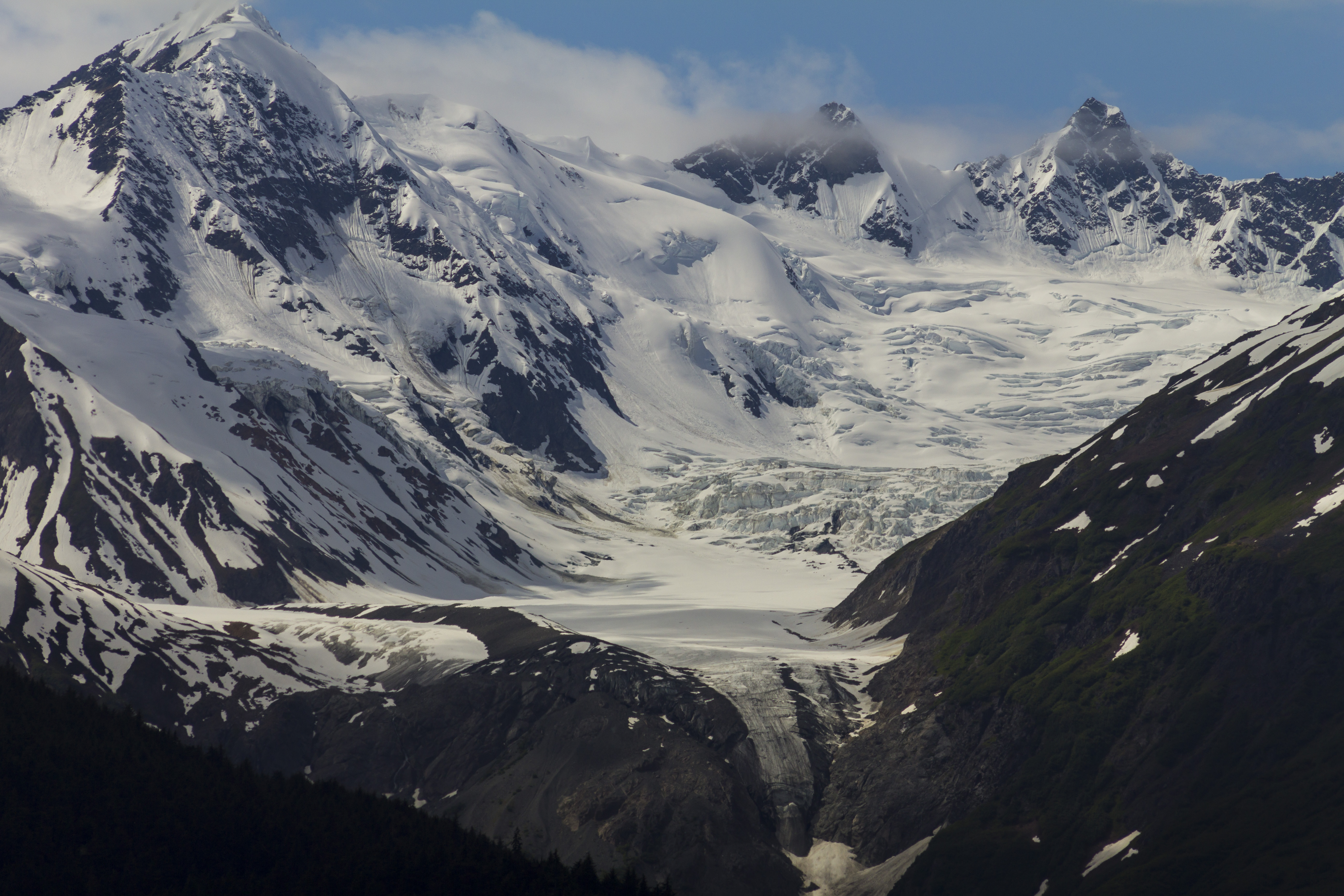
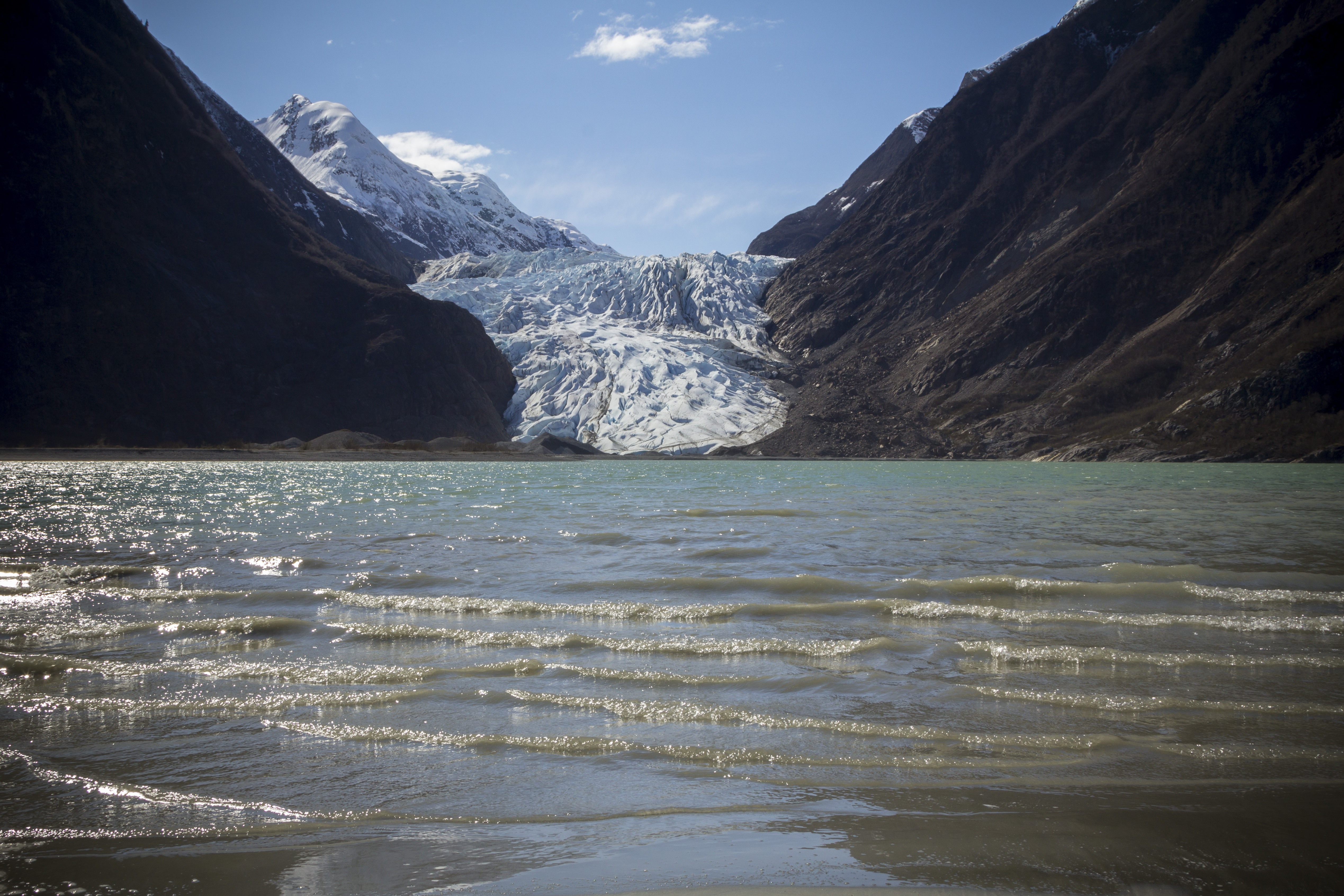
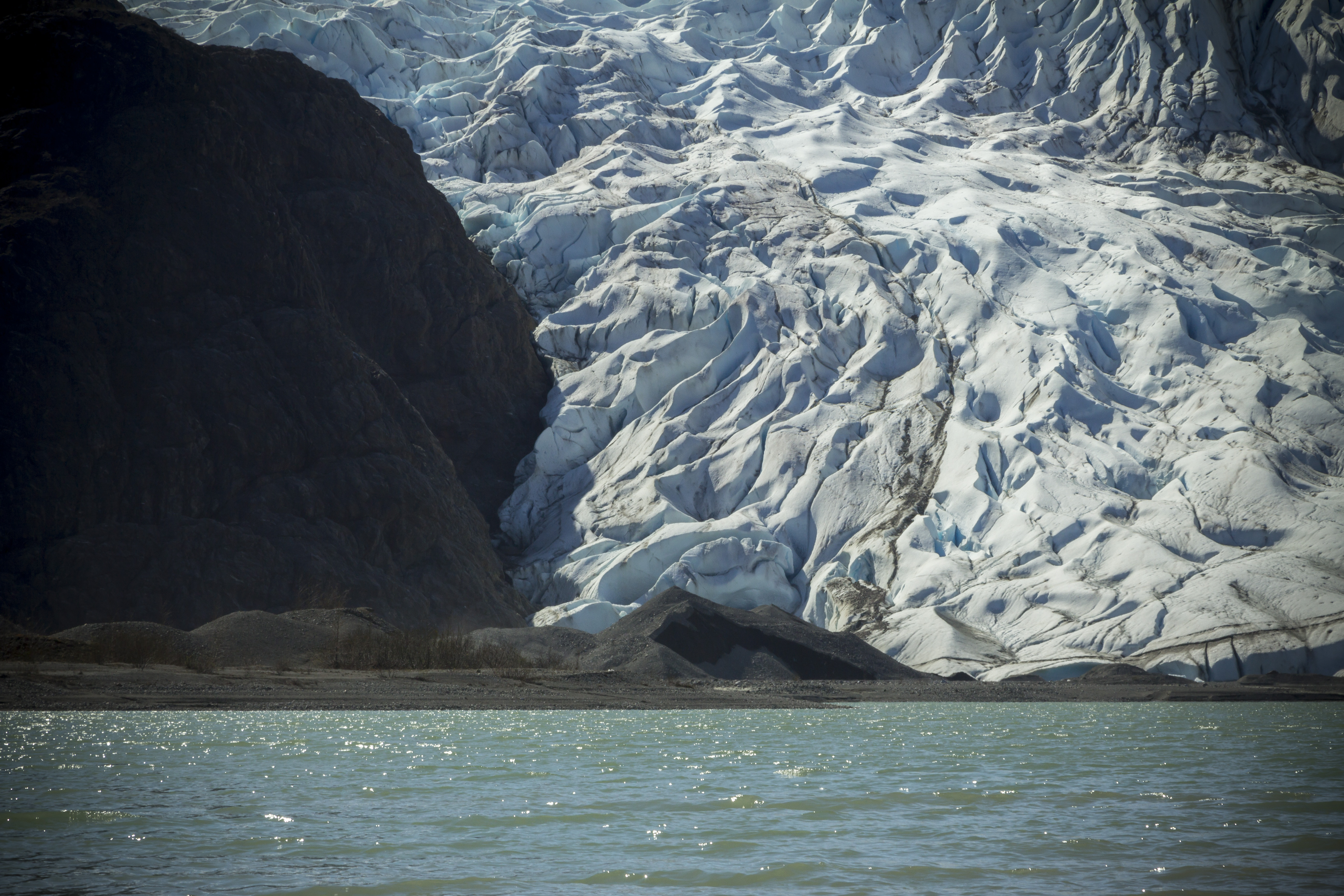
Fine spring weather and a weekend off urges me to pack up the skiff for a first -time-this-year-sailing. The 12 foot Lund has some leaky rivets, and the 39 year old Johnson 9.9 horse motor is about as decrepit as they come. Still, it was time to get out across the water and explore. I pack the boat and call Angela to roust her from whatever she was planning for the day, and soon we are humming along in dead calm ocean water; headed for the opposite side of the Chilkat Inlet to explore the Davidson Glacier and the areas around Glacier Point. We spot River Otters, Sea Lions, and Humpback Whales along the way. The weather is the sort you dream of in Haines: sunny and partly cloudy skies, warm temperatures, and not even a wisp of wind. Soon we are beached on the shores of Glacier Point, and before we can get camera gear into backpacks for a trek up to the glacier, we spot a Humpback whale surfacing and spouting it’s blow hole. Within seconds the creature is back in the depths and without notice, the Humpy has breached the water and is airborne. Our jaws drop, and we expect it to end there. Over the next 5 minutes or so, the Humpback breaches and spins and tail swats airborne style at least 10 more times, causing great and rewarding splashes. We are in awe of the spectacle we have just witnessed. I have never seen anything like it, not even close. I was so riveted by the performance, I refused to grab the camera for some action video. My dinky 105mm lens likely would have produced unsavory results anyhow. As it was, I’m certain I got much more out of the experience with out the camera in my hand. As much as I want so bad that great shot, I want the experience even more.
Soon we are trudging up the dirt access road to the Davidson Glacier where we marvel at the beauty of the magnificent and engaging ice, as well as admiring spectacular views of Mt Sinclair and Mt Elba and the bulk of the heavily glaciated Alaskan Coast Range visible north of Juneau. On the way back we find a flock of twenty strong Snow Geese nestled into the coastal grasses of the surf plane, catching up on some well earned rest.
That night, the wind picks up and we are thankful we had decided to pitch the tent after all. In the morning, we see the storm clouds a brewing and the wind picking up even further. A quick escape is in order, and soon the boat is packed and we struggle to get the tiny skiff past the swelling surf and into deeper water where we can fire her up. Soon the motor is running and we hightail it back up the inlet, punching the small vessel through the two to three foot swells. This feels like survival boating and Angela is wearing the only life preserver we have. For fear of capsizing the boat, I stay on the decaying throttle to keep the craft moving directy into the oncoming surf. I am white knuckled, cold, and concerned. After a bit, Letnikof Cove appears and soon we are pulling up to the boat ramp and loading the truck. The storm never actually took foot, but it sure made for some big waves in a little boat.
Spring time in the Chilkat Valley is an impressive time. Seems the whole of the world is coming alive and staying busy with fattening up after a (not so) long winter. As I was pulling out of my driveway yesterday, a Sow Moose and her very large yearling were clambering down Cemetery Hill on Mud Bay Rd, headed right for my house. Animals, after a long absence, are emerging from the forest, and can be seen nearly anywhere If your eyes and heart are open to it.
After a six day work week, I am tired, but ready to get out into the real world of forest and river and animal; to have a peek and to get myself right with the world again. I head out around 9:30 Sunday morning and drive north up the Haines Highway. It is raining slightly, but it is not a bother to me. I want to head to a place at 25 mile I know of to look for and to shoot video of Moose. I drive slowly and in a manner of no hurry what so ever. Eyes peeled left, I see an animal on the shores of the only inches deep Chilkat. It appears at first to be a Lynx, but as it turns, I see that it is either a young and lone Wolf, or more than likely, a large Coyote. I pull off the road and the animal drops what it is eating and scrambles up the far embankment. Not wishing to disturb the creature’s fine and tasty meal, I too scramble back onto the road way and wish the Canine farewell. I get to the mudslide area at 19 mile and look out over the sandy river braids and spy two Eagles in a tree top. Between them is a nest the size of my pickup bed. They appear to be guarding it, and once again, I leave them in peace.
After a bit I am nearing the place I want to go, but realize after crossing the Chilkat bridge, there is far too much snow for my two wheel drive truck to handle on the dirt road leading back to the area in question. Reluctantly, I turn around and head back down valley, moving as slowly as before thinking the right place will pop up. At 18 mile, I turn into a pull out and descend into the bushes and thickets leading to the innards of the forest. Camera and tripod are heavy, but I figure it would be worth it to get a shot. Good and sellable clips are rarely placed in front of you, at least when it comes to animals, although I do know some folks with homes situated as to have their own private wild animal zoo in their backyards. I am happy to be thrashing into this forest however. Soon I am on a game trail and Moose dropping appear, though hard to say how old they are. I hear a creek ahead, and I stumble upon what is quite obviously a major Bear/Salmon area, The shores of the creek are heavily trampled, and lying about are many lower jaw bones of last years run. The area is so heavily used looking, I can imagine this place has been a Bear feeding ground for untold centuries. This place is a treasure, and I continue on, contemplating how dangerous it might be in a few short months when the fish are spawning again and the Brown Bears are out feasting. Back at the truck, I head down valley and spot, on the other side of the river, fifteen to twenty Canada Geese on a layover in a massive field. Further out, a moose is grazing peacefully. Having only my Xtra Tuff’s on, I swear to myself I will always carry my hip waders in the back of the truck. I drive through town and down the peninsula, where there are perhaps eight or nine Eagles feasting on the Sleeper Shark that washed ashore last week. On the drive home, I pull off to watch an Otter bobbing it’s head as it swims parallel to the shore in search of fish.
Sure is a spectacular time of year here in Haines…never got even one single shot. Didn’t matter.
Living at nearly 60 degrees north latitude is an interesting experience in regards to the seasonal changes and the Earth’s placement in the solar system as it rotates around the sun. Prudhoe Bay on the Alaska’s north slope is exasperated even more so, but even here in Haines, at a little over 59 degrees north latitude, one really notices a significant change in the length of the days starting in March; we now have nearly 14 hours of daylight, and the sun is gaining elevation in the sky daily. The midnight sun is approaching and soon the Bears will exit their den’s and the Salmon will begin to run. It is a glorious time of year in this neck of the woods…
Even before moving from Fairbanks to Haines last November, then as now, Google Earth has been a friend to me insofar as giving me an opportunity to seek out many of Haines’ lesser known treasures. I remember the evenings in the cabin up on Himalaya Road, north of Fairbanks 30 miles or so, after my chores tending to the sled dogs were over for the day; I would skim the earth utilizing this amazing piece of technology to familiarize myself with the place I knew would become my home.
Last April, after the bulk of the winter’s snow had become a molecular part of the heavens’ above, I decided to drive out to explore an area I had “discovered” by means of the previously mentioned technology. But after getting out there, I became confused with what road was what, and not wanting to get tangled into someone’s property, I abandoned ship and opted for a hike across Mud Bay proper and over it’s adjoining ridge through the area’s old growth forests.
This morning looked reasonable, weather-wise, so I decided to let the Ogre out of the corral and saddle up. It was chilly out, but at least it wasn’t raining, and the cool wind felt downright invigorating. Spinning softly along the shores of the Chilkat inlet, I whizz past Letnikof Cove and the small harbor there, past the old cannery, through the Community of Mud Bay, past the road to Chilkat State Park, and on the the seemingly dead end of Mud Bay Road itself. This where I had been deterred before, but was determined to find what I was looking for.
The Chilkat Penninsula, at just over 59 degrees north latitude, holds 2 or 3 tiny lakes on the flanks of it’s forested hills overlooking the Lynn Canal and it’s various arms. The most commonly known lake is Lilly Lake, which also serves as the drinking water supply for our little town. One other tiny lake, more remote than Lilly, called Rustabach Lake was what I wanted to see.
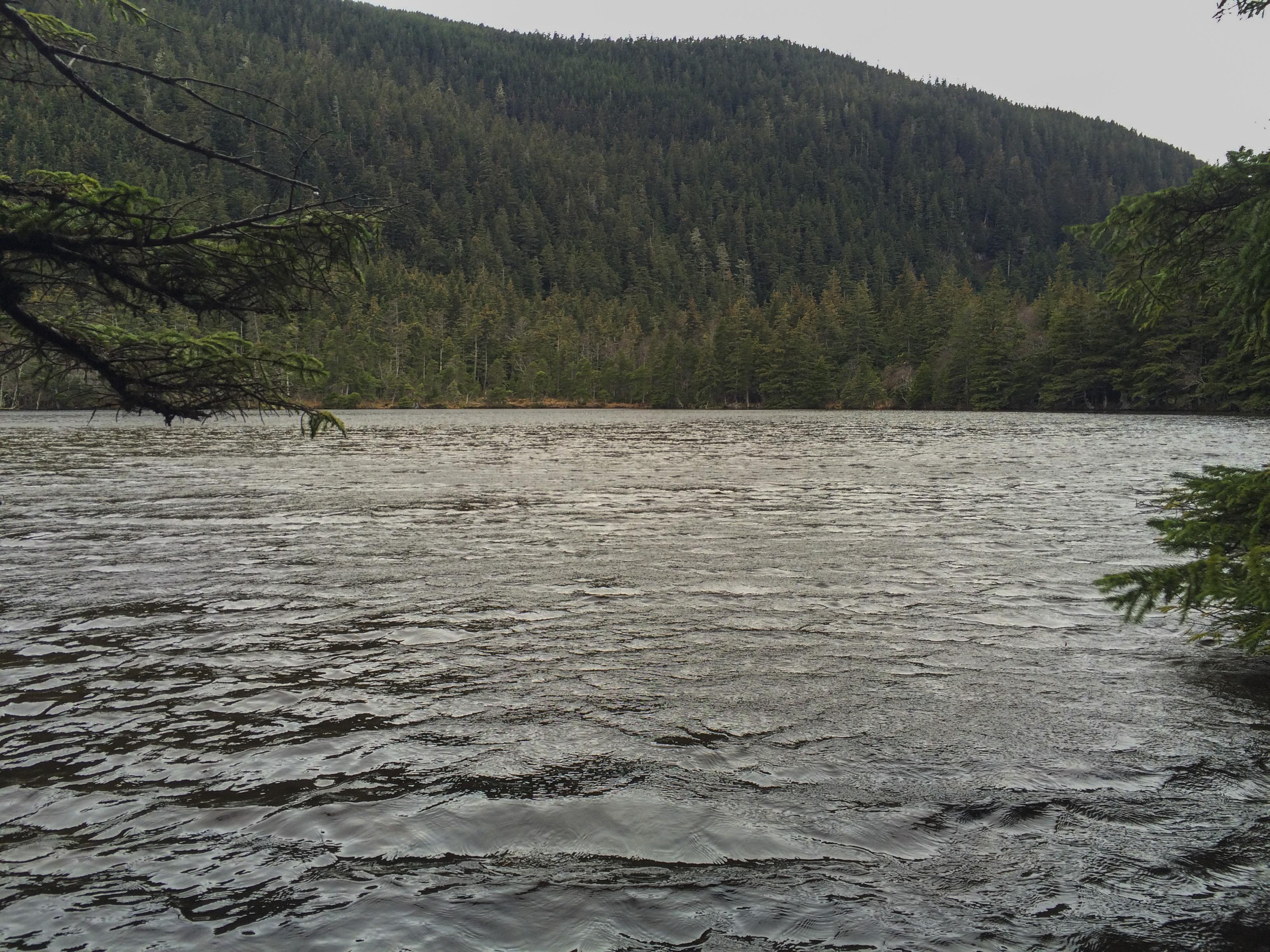
The Ogre seems to have a third eye for this sort of thing, so I shrug my shoulders and hang on for a steep climb up the narrow dirt track leading upward. Shifting into the wee tiny gears of the upper end finds us at a pull out about a mile up. I stop and can see that there is a well traveled trail leading from the pull out and decide that a short hike is in order. Not far into the old growth forest, the trail is smooth and I figure must lead to someone’s cabin. After a short bit, there is the Lake! Rustabach! It appears smaller than Lilly Lake and perhaps a shallow one at that, but it is a peaceful place surrounded by magnificent forest and some of the thickest, greenest moss forest carpet I have ever seen. I walk back to the bike and we continue on up the road and finally come to someone’s beautiful cabin homestead, complete with a big green peace symbol on it’s woodshed. Not wanting to disrupt, we turn around for a fast and fun blast down the road to the saltwater, where big views of Alaska’s great Coast Mountains and her mighty glaciers are visible. Also visible, is a storm quickly approaching from the open waters of Icy Strait, not far south. The peaks are quickly engulfed and the Ogre and I head back to from where we came…
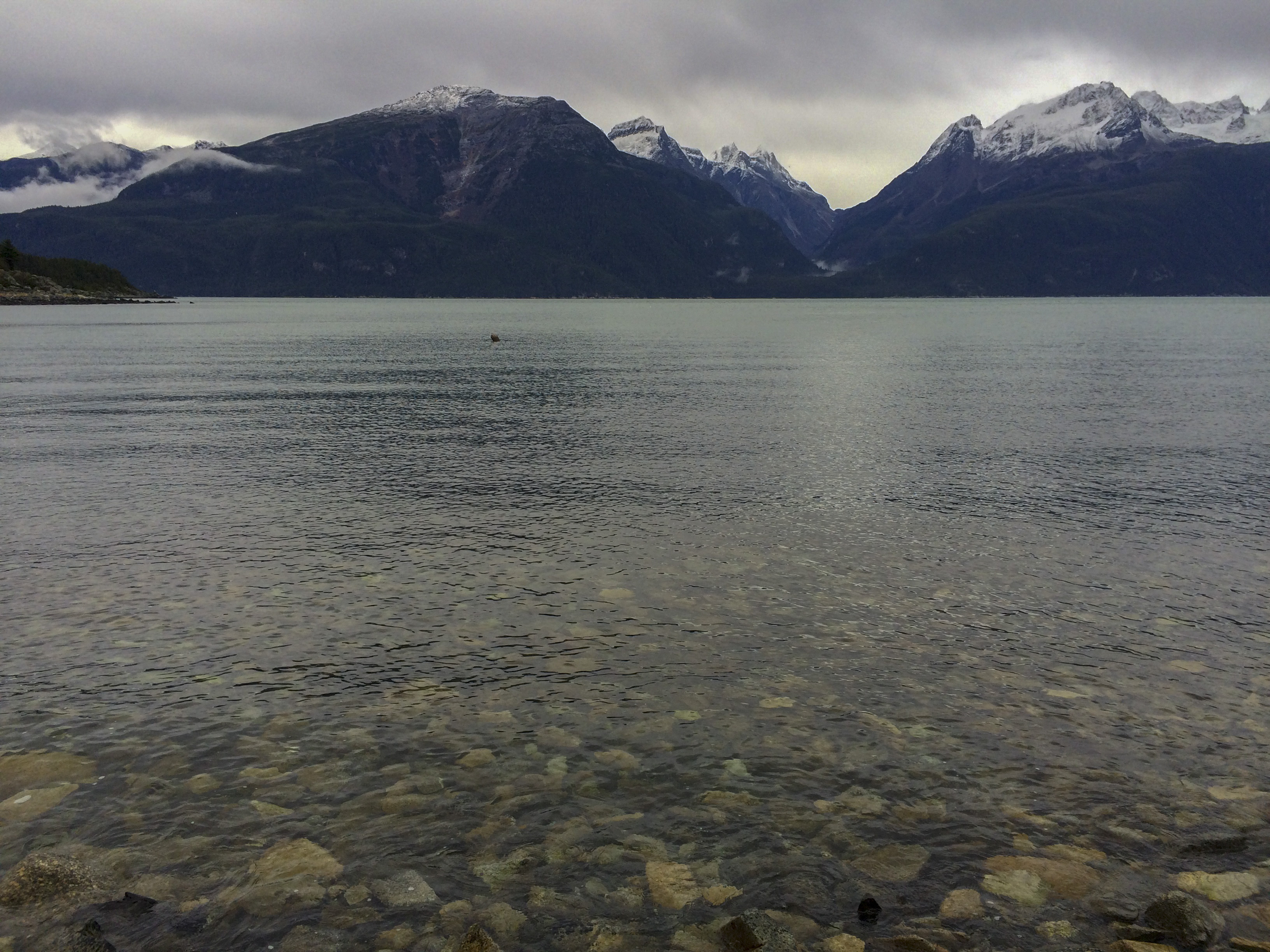
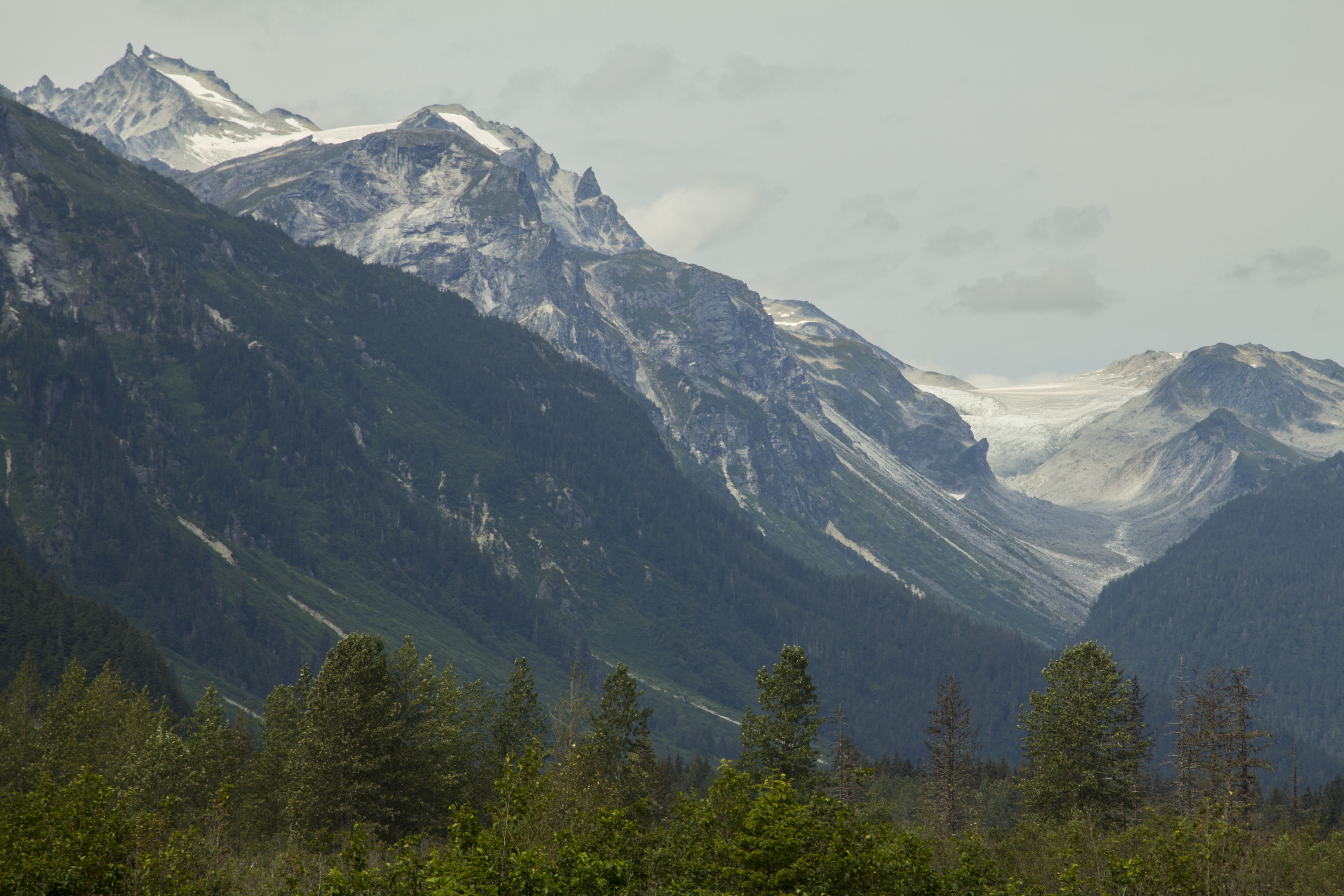
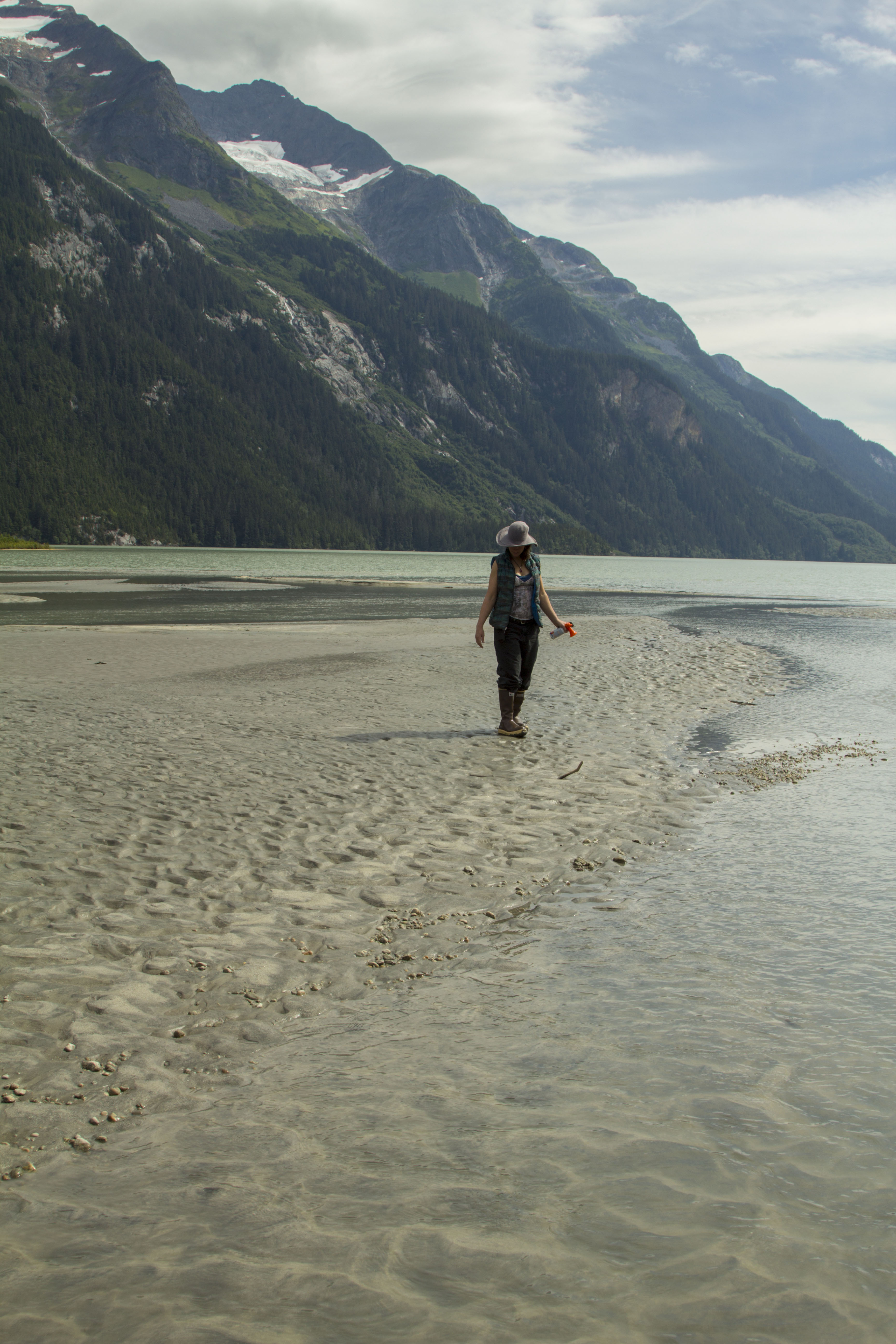
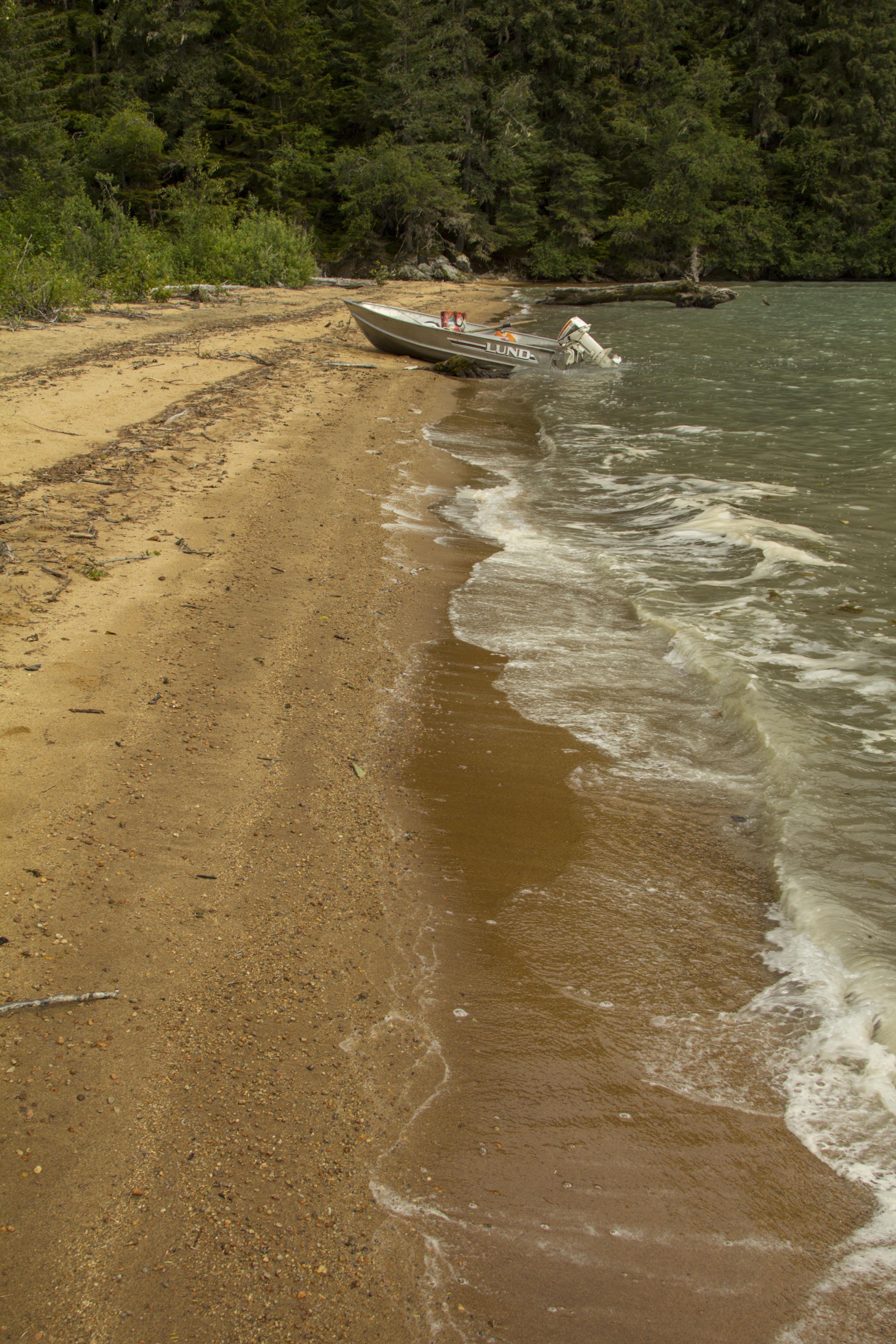
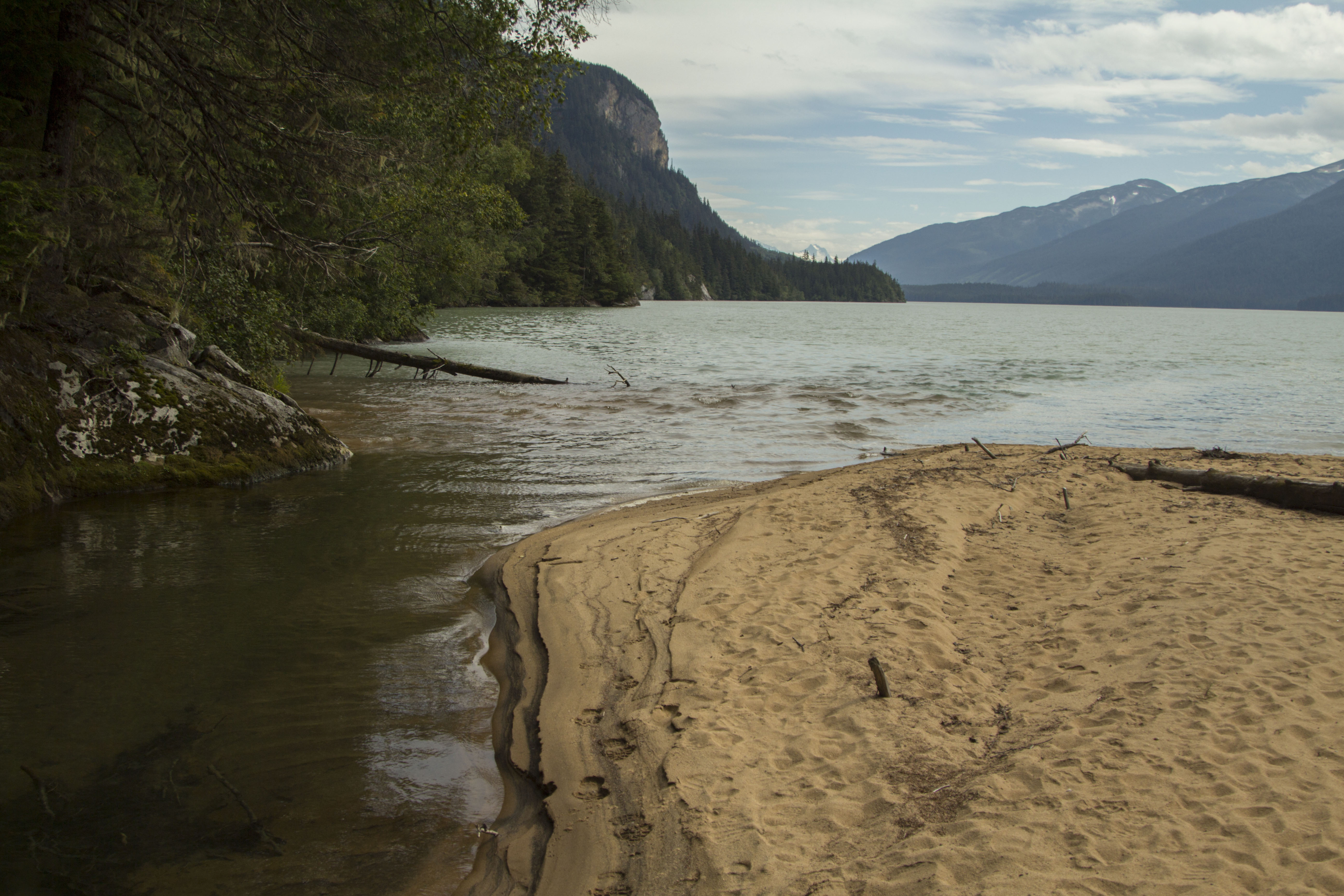
Living in Haines, in particular, the Chilkat Peninsula, and being surrounded by salt water and rivers’ galore, the concept of having a boat, in all of it’s magnificent access abilities, seems as important a vehicle as any. The vessel available to us at time’s being is a Lund 12′ craft of the skiff variety, which sports a small 10hp Johnson motor. Other craft’s would be a pleasure to captain as well, such as a canoe or sea kayak, but the Lundy is what we’ve got and a day out to explore the fabulous waterways of our home is in order. Forgoing the “event of the year” in Haines, the annual Southeast Alaska State Fair, we opt to load the boat into the truck (sans trailer) and head out to Chilkoot lake for a looksie.Chilkoot Lake is a spectacle to behold for sure: a milestone of a lake it is situated at the bosom of the Takahshini Mountains, is fed by the world famous Salmon fed Chilkoot River, and is surrounded by peaks, waterfalls, glaciers, and Bears. The lake’s out feed river, the Lower Chilkoot, is only 1 mile long before dumping itself into the mighty sea by means of the Lutak Inlet. This stretch of river sports one of the mightiest Sockeye Salmon runs in the state, and is usually adorned with fisherman from abroad, hoping to land a fish. Above said stream, is Chilkoot Lake and above the pond lie one of Southeast Alaska’s mighty wilderness rivers’: The Upper Chilkoot. Where the Upper Chilkoot enters the lake, a great sandy stretch of freshwater coastline angls off to form what is affectionately known as “Bear Beach”.We drive out past the hoards of Fair goers onto the Lutak Road and sneak up the Chilkoot road to it’s end and set the boat, and ourselves adrift. A cruise up lake reveals a new vantage and we are rewarded by hidden glaciers and more eye dropping waterfalls. About 3 miles out we come to the lake’s end and we find our selves moored upon the beach head known as “Bear Beach”. Immediately upon abandoning ship, Brown Bear prints are seen and we come to realize the nature of it’s given name. Angela scrambles off to follow the prints and soon is fiording the raging Chikoot River in an attempt to continue following the Bear’s path. Soon the water is higher than the Extra Tuffs that adorn her feet, and she then sheds boots and clothing alike for a true Alaskan river crossing. Not being so bold, I decide to stick to the adjecent shore in hopes of joining her further up river. I too come to my own adventure shortly thereafter, and soon find myself deep in Alder thickets and Sedge grass waist deep, with Bear trails criss crossing the landscape. I begin my chanting of bear talk in an attempt to warn the large, furry critter’s of my presence. Bear beds and more prints scatter the shoreline and soon I see Angela attempting to wade back across to a lagoon that might access the previous shoreline. Soon she is wading thigh deep, naked as the day she came with Extra Tuff’s in hand and the most serious set of Bear trails I have seen swirling around us. A quick stomp through the Alder thickets and Devil’s Club singing bear songs, brings us back to the beach where we ponder the situation. Back in the boat and headed back from where we came, a few more stops at small creeks and inlets rewards us with spawning Salmon, more beautiful forest and waterfalls, and another fine day in Alaska.



































 Just Rolling By
You must be logged in to post a comment.